Athens: After the Arrival City
2022 - 2025
The city of Athens has played a significant role during the so-called ‘European Migrant Crisis’, as a major ‘Arrival City’ for refugees since 2015, where over 1 million people came to Greece in the first year. Seven years on, the end of 2022 will see the close of the European refugee housing support programme (ESTIA), which will bring about great uncertainty for an estimated 13,000 people in Athens, who have sought to make the city their home over recent years.
After the Arrival City (2022-) addresses the close of ESTIA and seeks to understand how a city without an existing model for rented social housing can adapt to find new ways to support and accommodate people in displacement. Taking a place-based architectural approach, the project aims to support the development of robust and equitable research partnerships with local and international institutions working in Athens on questions of migration and urban development, housing and social infrastructure.
2022-23: Exarcheia, Kypseli, Profsygika (Alexandras Avenue)
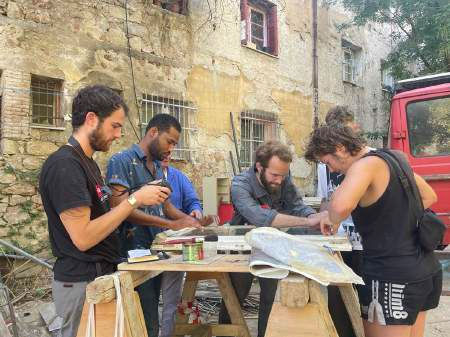
By locating the unit within the current, critical exchange about the future of refugees in Athens, we interrogated an area of investigation in and around the centre of the city – in three neighbourhoods: Exarcheia, Kypseli and the Prosfygika.
Exarcheia is the centre of civilian resistance and protest in contemporary Athens, ever since the first Athenian resistance group was formed there in WWII to overcome the Nazi invasion. The neighbourhood plan is centred on Exarcheia Square, formed by a gap in clashing city grid lines. Whilst in Athens, we attended a protest calling for the reclamation of Exarcheia Square from government control. We met with many local residents, who told us the history of the area, and talked us through their struggle with rising rents, the closure of local businesses and the rapidly changing identity of Exarcheia as a result of privatisation.
Kypseli lies roughly 30-minutes north-east of Omonia square. An expansive neighbourhood, it is primarily characterised by its constant evolution. While Athenians know Kypseli as a centre for arts and culture, our experiences and conversations with locals revealed more about its shifting history. Today, Kypseli is one of the most ‘multicultural’ neighbourhoods in the city. It was built, like much of Athens, following the second world war by Greek migrants coming to Athens for the opportunity of a better life. We quickly noticed through our mapping and conversations with locals that immigrants were more visible in certain areas than others, almost intentionally.
Prosfygika is a complex of eight modernist buildings surrounded by large institutional buildings in the Northeast of Athens, away from the cramped and
busy streets. Between the buildings, six cool, shaded courtyards provide an oasis away from noise and heat. The buildings originally accommodated
refugees in 1935 coming from Asia Minor. Prosfygika functions as a squatted community thanks to its ‘structures’: groups that make up a general
assembly, can vote on decisions and organise activities and spaces which help them be selfsufficient, without (and in resistance of) government intervention.
2023-24: Neos Kosmos
Neos Kosmos features a mix of diverse physical and social infrastructure, including historical refugee housing, flea markets, Armenian churches, community gardens, and polykatoikia blocks. The area also offers amenities such as a clinic, sports courts, and elderly and youth centres, situated among
tram lines, parks, public gardens between buildings, and motorway edges. The Dourgouti Bauhaus estate is defined by a combination of official and unofficial
boundaries.
2024-25: Tavros
Concluding a 3-year investigation into housing, social infrastructure and people in displacement, Unit 6 focussed their final field research within the urban neighbourhood area of Tavros located 3km West of Central Athens - a historical area of ‘arrival’ and settlement for refugees and migrants for over a century. Tavros features various housing types and industrial developments that chart the progress of city building and urban integration in Athens since the early 20th century.